How to remove the Claude watermark from a text (and what does not work)
Find-and-replace, spell checkers and light edits do nothing against a statistical watermark. Here is what actually neutralises it, what it costs you in meaning, and how Unmarker approaches the problem.
Why the usual tricks do nothing
Most "remove the AI watermark" advice online was written for a different problem: invisible Unicode characters, metadata in files, or style-based detectors. Anthropic's text watermark is none of those. As explained in our explainer, it is a statistical bias in the choice of words, computed with a key Anthropic holds. That single fact rules out a whole list of habits:
- Paste as plain text, strip formatting, re-save as .txt. No effect. There is nothing in the formatting to strip.
- Search for hidden characters (zero-width spaces, non-breaking spaces, homoglyphs). You will not find any; that is not how this mark works.
- Run a spell checker or a grammar tool. It changes a handful of words out of hundreds. Nine tenths of the signal remain.
- Swap synonyms here and there, reorder two paragraphs. Same problem, in a different coat: a statistical detector counts over the whole text and shrugs at a 10 % change.
- Ask Claude to "rewrite this so it is not detected". The rewrite is generated by Claude, so it is watermarked again, and you have just spent a request producing a fresh mark. This is the most common mistake we see.
What actually neutralises the mark
Anthropic's own list of what makes the mark disappear is short: text that is "heavily edited, paraphrased, translated, or mixed into other writing." Each of these attacks the same thing, the alignment between the words on the page and the key-dependent "preferred" word sets. Whatever method you use, check the text with the Claude watermark detector afterwards: the score, not the effort, tells you whether the mark is gone.
1. Deep paraphrase
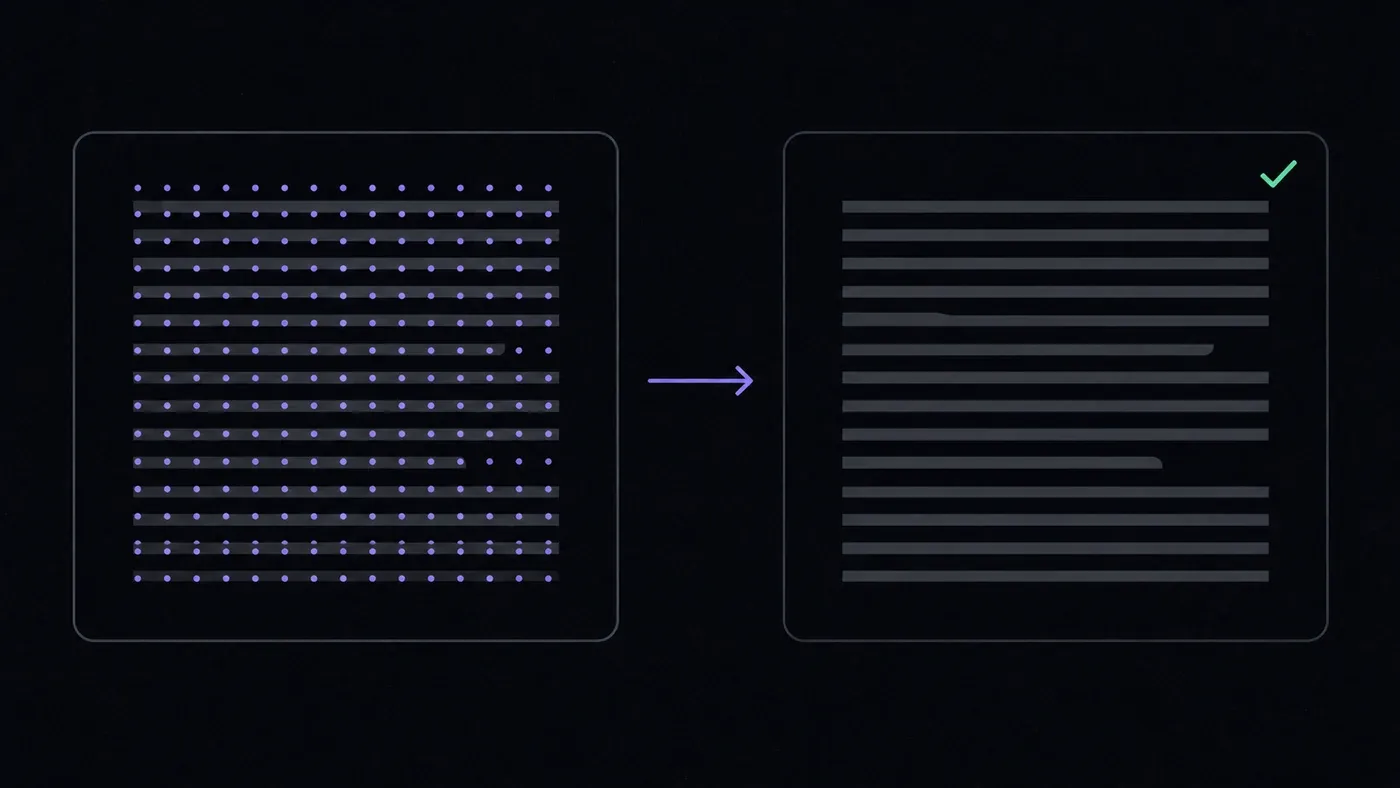
Rewrite most sentences so that most word choices change. In our tests with published statistical schemes, changing roughly a third of the words in a sentence leaves the sentence weakly marked; changing well over half of them, including function words and clause structure, brings the sentence back to chance level. Do that across the document and the document-level score follows. The cost is obvious: it is a full rewrite, and doing it by hand on a 2,000-word text takes as long as writing it. The less obvious cost is meaning drift. A human rewriting fast, or a model rewriting freely, will soften a claim here and drop a qualifier there.
2. Round-trip translation
Translate the text into another language and back with a system that is not Claude. Word choices in the returned English are new, so the mark is gone. Quality is the issue: round-trip translation flattens style, mangles idioms and terminology, and produces text that a style-based detector will happily flag as machine-like. It also does not help if your target language is the output.
3. Rewrite with a model that is not Claude
Ask another vendor's model to paraphrase. Depending on the vendor, you get an unmarked text (OpenAI has not switched on a text watermark as of August 2026, per Forbes' account of Wall Street Journal reporting) or a text carrying that vendor's mark instead (Google's SynthID-Text on Gemini). Either way you have swapped the problem, and you still have no meaning check and no diff.
Combining methods
People sometimes stack these: translate, then lightly edit, then run a grammar tool. Stacking does not add much beyond the strongest step. If the paraphrase was deep, the mark is gone and the extra passes only cost you meaning; if it was shallow, no amount of reformatting on top will fix that. The single question that matters is: what fraction of the word choices in each sentence are new? Everything else is decoration.
4. Dilution
Bury the marked passage in a much longer human text. This lowers the document-level score but leaves the marked paragraph intact for any detector that works paragraph by paragraph. It is not removal; it is hiding, and it is fragile.
The options, side by side
| Method | Removes the mark? | Keeps your meaning? | Keeps formatting? | Effort | Notes |
|---|---|---|---|---|---|
| Reformat, plain text, spell check | No | Yes | Yes | None | Nothing to remove; the mark is in the words. |
| Light manual edits (a few words per paragraph) | No, only dilutes | Yes | Yes | Low | Detectable on any text of a few hundred words. |
| Manual deep paraphrase | Yes, if thorough | Depends on you | Yes | High | Roughly the time it takes to write the text again. |
| Round-trip translation | Yes | Partly, idioms and terms suffer | Often lost | Low | Flat, machine-like result. |
| Ask Claude to rewrite | No | Mostly | Yes | Low | New Claude output, new mark. |
| Rewrite with another vendor's model | Yes, or swaps the mark | Unchecked | Usually | Low | No diff, no meaning check, possibly a Gemini mark. |
| Unmarker (planned) | Targets the mark, shows before / after estimate | Checked sentence by sentence, drift flagged | Yes, Markdown and HTML | Low | Meaning lock, diff, bulk and API. Early access first. |
How Unmarker approaches it
The Claude watermark remover automates the only method that works, deep paraphrase, and adds the controls that make it safe to use on text you care about.
- Score the input. An estimated watermark score for the pasted text, so that you do not rewrite a text that is too short to carry a signal, or that is not marked at all.
- Rewrite at the word-choice level. The engine changes wording and clause structure across every sentence, not a synonym here and there, while keeping names, numbers, quotes, links, code and formatting fixed.
- Lock the meaning. Every output sentence is compared with its source sentence. If the comparison finds a dropped qualifier, a softened claim or an added idea, the sentence is flagged and rewritten again before you see it. You get a diff of every change.
- Score the output. The same estimate, after. You decide when it is good enough; the tool does not claim a number it cannot measure.
Two honest limits. First, the estimate is ours, not Anthropic's: Anthropic has not published its detector, so any before / after score is a model of the mechanism, presented as such. Second, Unmarker targets the watermark, not third-party style detectors; a plain, well-edited text may still be called "AI-like" by a tool that judges style. We do not use absolute language about either.
Should you remove it at all?
Sometimes the right answer is no. If a client, an employer, a school or a publisher asks you to disclose AI assistance, the watermark is not your problem, disclosure is, and neutralising the mark does not discharge that obligation. If, on the other hand, you wrote the text and used Claude the way you would use a spell checker or a translator's glossary, and a downstream checker now labels your work "AI-written", a meaning-preserving rewrite returns your text to a state where it reads as yours. That is the case Unmarker is built for. Join the early access list to be in the first batch.
Sources
- Anthropic Help Center, "How Claude marks AI-generated content", consulted August 15, 2026: support.claude.com/en/articles/16266773
- Forbes, "Claude will now leave a watermark on everything it writes. What does that mean?", August 13, 2026: forbes.com
- Kirchenbauer et al., "On the Reliability of Watermarks for Large Language Models", 2023 (robustness to paraphrase and edits): arxiv.org/abs/2306.04634
- Google DeepMind, SynthID-Text, Nature, October 2024: nature.com